
What Are Fenugreek Sprouts?
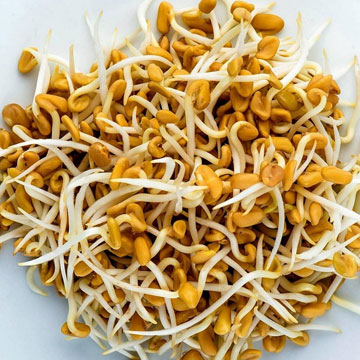
Fenugreek sprouts are young edible shoots produced when fenugreek seeds (Trigonella foenum-graecum) germinate under warm and moist conditions. Typically harvested within 3–5 days, fenugreek sprouts are valued for their distinct slightly bitter, nutty flavor and their long-standing role in traditional diets, particularly in South Asian and Middle Eastern cuisines.
Compared to mature fenugreek seeds, sprouts offer improved digestibility, reduced anti-nutritional compounds, and enhanced bioavailability of certain vitamins and minerals. Fenugreek sprouts are commonly consumed fresh, lightly cooked, or incorporated into salads, curries, and savory dishes.
Fenugreek sprouts should not be confused with mature fenugreek leaves (methi), which are harvested later and used as leafy greens.
Nutrition Facts
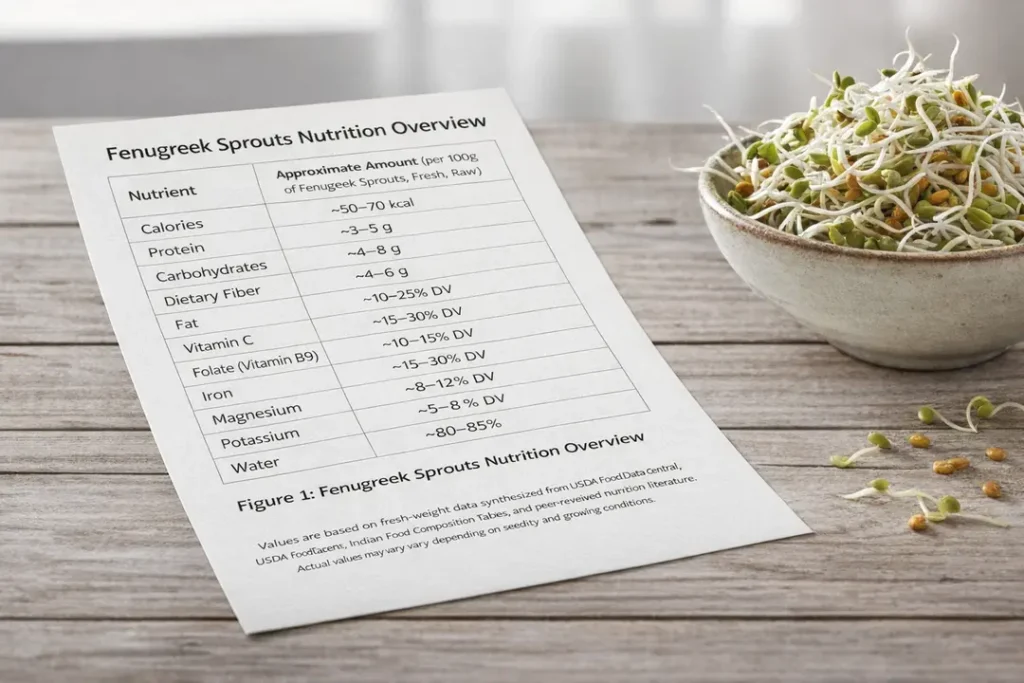
Nutritional Overview per 100g of Fenugreek Sprouts (Fresh, Raw)
| Nutrient | Approximate Amount |
|---|---|
| Calories | ~50–70 kcal |
| Protein | ~3–5 g |
| Carbohydrates | ~4–8 g |
| Dietary Fiber | ~4–6 g |
| Fat | ~1–2 g |
| Vitamin C | ~10–25% DV |
| Folate (Vitamin B9) | ~15–30% DV |
| Iron | ~10–15% DV |
| Magnesium | ~8–12% DV |
| Potassium | ~5–8% DV |
| Water | ~80–85% |
Values are based on fresh-weight data synthesized from USDA FoodData Central, Indian Food Composition Tables, and peer-reviewed nutrition literature. Actual values may vary depending on seed quality and growing conditions.
Figure 1: Fenugreek Sprouts Nutrition Overview
Bioactive Compounds and Functional Nutrition
The germination of fenugreek seeds activates a range of biochemical changes that enhance nutritional quality:
- Reduction of anti-nutritional factors, such as phytic acid
- Increased enzymatic activity, aiding digestion
- Presence of polyphenols and antioxidant compounds
- Improved mineral absorption (iron, magnesium)
Fenugreek sprouts also retain trace amounts of saponins and alkaloids, compounds traditionally studied for metabolic and digestive effects. However, most functional claims are supported by preclinical or observational studies, and further human research is required.
Potential Health Benefits (Evidence-Based)
The following information summarizes findings from nutritional science and does not constitute medical advice.
Digestive and Gut Support
The relatively high dietary fiber content of fenugreek sprouts may support normal digestion and bowel regularity.
Plant-Based Protein Contribution
Fenugreek sprouts provide moderate plant protein (~3–4 g/100g), contributing to dietary protein intake without excessive calories.
Micronutrient Support
Notable levels of folate, iron, and magnesium support general metabolic function and red blood cell formation when consumed as part of a balanced diet.
Antioxidant Properties
Natural antioxidants found in sprouts may help reduce oxidative stress, although clinical significance remains under investigation.
Risks and Food Safety
Risk of Microbial Contamination
Like all raw sprouts, fenugreek sprouts are grown in warm, humid environments that may support bacterial growth, including Salmonella and E. coli.
Recommendations for High-Risk Groups
Pregnant individuals, young children, elderly adults, and immunocompromised persons are advised to avoid raw sprouts or consume them only after thorough cooking.
Safe Handling Guidelines
- Rinse sprouts thoroughly before use
- Store refrigerated
- Consume shortly after harvest
- Light cooking significantly reduces microbial risk
These practices align with CDC and FDA food safety guidance.
Home Sprouting Guide (How-To)
Fenugreek sprouts are well-suited for home sprouting projects and require minimal equipment.
Materials Needed
- Edible-grade fenugreek seeds (raw, untreated)
- Sprouting jar or tray with breathable lid
- Clean water
Standard Sprouting Steps
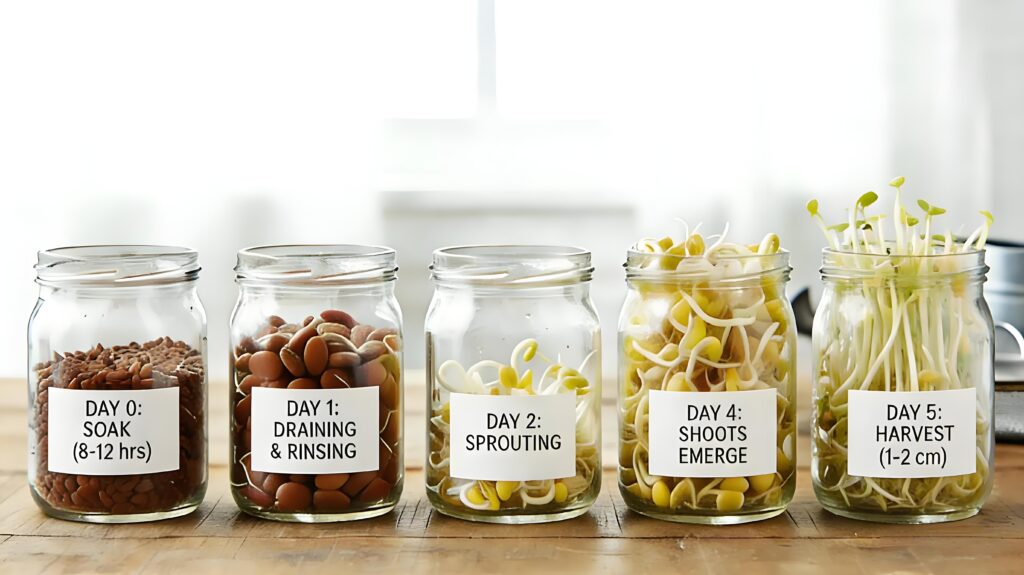
- Soaking: Soak fenugreek seeds in clean water for 8–12 hours.
- Draining & Rinsing: Drain soaking water, rinse thoroughly, and drain completely.
- Sprouting Container: Place seeds in a ventilated sprouting container.
- Daily Rinsing: Rinse 2–3 times daily to keep moist without standing water.
- Harvest: Sprouts are typically ready in 3–5 days, when shoots reach 1–2 cm.
Figure 2: Fenugreek Sprouts Growth Timeline (0–5 Days)
How to Eat Fenugreek Sprouts
Fenugreek sprouts are versatile and commonly used in:
- Salads: Often combined with lemon, salt, and mild vegetables
- Stir-fries: Light cooking softens bitterness
- Curries & stews: Traditional use in Indian dishes
- Grain bowls: Mixed with legumes or cooked grains
Cooking reduces bitterness and improves safety for sensitive individuals.
Fenugreek Sprouts vs. Other Common Sprouts
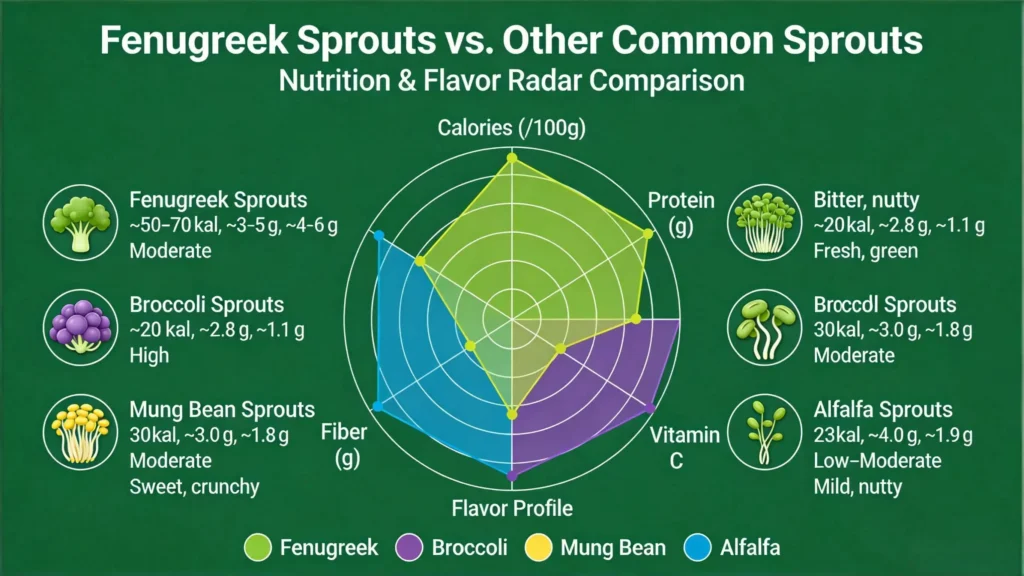
| Metric | Fenugreek Sprouts | Broccoli Sprouts | Mung Bean Sprouts | Alfalfa Sprouts |
|---|---|---|---|---|
| Calories (/100g) | ~50–70 kcal | ~20 kcal | ~30 kcal | ~23 kcal |
| Protein | ~3–5 g | ~2.8 g | ~3.0 g | ~4.0 g |
| Fiber | ~4–6 g | ~1.1 g | ~1.8 g | ~1.9 g |
| Vitamin C | Moderate | High | Moderate | Low–Moderate |
| Flavor Profile | Bitter, nutty | Fresh, green | Sweet, crunchy | Mild, nutty |
Figure 3: Sprouts Nutrition & Flavor Radar Comparison
Frequently Asked Questions (FAQ)
Can fenugreek sprouts be eaten every day?
Moderate daily consumption is generally safe for healthy adults when sprouts are properly handled.
Are fenugreek sprouts bitter?
Yes. Fenugreek sprouts have a naturally slightly bitter, nutty flavor, which can be reduced by light cooking.
Are fenugreek sprouts the same as fenugreek leaves?
No. Sprouts are harvested during early germination, while leaves (methi) are mature greens.
Are fenugreek sprouts more nutritious than seeds?
Sprouting improves digestibility and mineral bioavailability, though seeds remain more calorie-dense.
References & Data Sources
- USDA FoodData Central
United States Department of Agriculture.
Fenugreek seeds and sprouted legumes – nutrient composition data.
https://fdc.nal.usda.gov/ - Indian Food Composition Tables (IFCT 2017)
National Institute of Nutrition (ICMR), Government of India.
Nutrient composition of fenugreek seeds and sprouted forms.
https://www.nin.res.in/ifct2017/ - FAO / INFOODS Databases
Food and Agriculture Organization of the United Nations.
Food composition data for legumes and sprouts.
https://www.fao.org/infoods/infoods/tables-and-databases/en/ - US Centers for Disease Control and Prevention (CDC)
Food Safety of Sprouts – Risk of Foodborne Illness.
https://www.cdc.gov/foodsafety/foods/produce/sprouts.html - U.S. Food & Drug Administration (FDA)
Sprout Safety and Consumer Guidelines.
https://www.fda.gov/food/buy-store-serve-safe-food/sprouts-what-you-should-know - Gan, R. Y., et al. (2017).
Bioactive compounds and health benefits of sprouted legumes.
Trends in Food Science & Technology, 59, 1–14.
https://doi.org/10.1016/j.tifs.2016.11.010 - Khattab, R. Y., & Arntfield, S. D. (2009).
Nutritional quality of legume seeds as affected by some physical treatments.
Food Science and Technology, 42(6), 1113–1118.
https://doi.org/10.1016/j.lwt.2009.02.008
Data Notes
- All nutritional values are expressed per 100g fresh (raw) fenugreek sprouts, not dry seeds.
- Values represent averaged ranges across multiple authoritative databases and peer-reviewed studies.
- Actual nutrient content may vary depending on seed variety, sprouting duration, temperature, and moisture conditions.
Comparison Tool Data Snapshot
This table is generated from the same data module as the Sprout Nutrition Comparison Tool, so this guide and the interactive comparison stay synchronized. Values are per 100 g fresh weight. “≈” means a species- and stage-matched reference estimate, not a direct measurement of every crop.
| Growth stage | Calories (kcal) | Protein (g) | Fiber (g) | Vitamin C (mg) | Folate (µg) | Iron (mg) | Calcium (mg) | Potassium (mg) |
|---|---|---|---|---|---|---|---|---|
| Whole Sprout | ≈ 60 kcal | ≈ 4.4 g | ≈ 2.2 g | ≈ 3.5 mg | ≈ 57 µg | ≈ 4.5 mg | ≈ 80 mg | ≈ 469 mg |
| Microgreen / Shoot | ≈ 45 kcal | 2.18 g | ≈ 3.5 g | 85.11 mg | ≈ 110 µg | ≈ 4.3 mg | ≈ 120 mg | ≈ 113 mg |