🥬 1. What Are Lentil Sprouts?
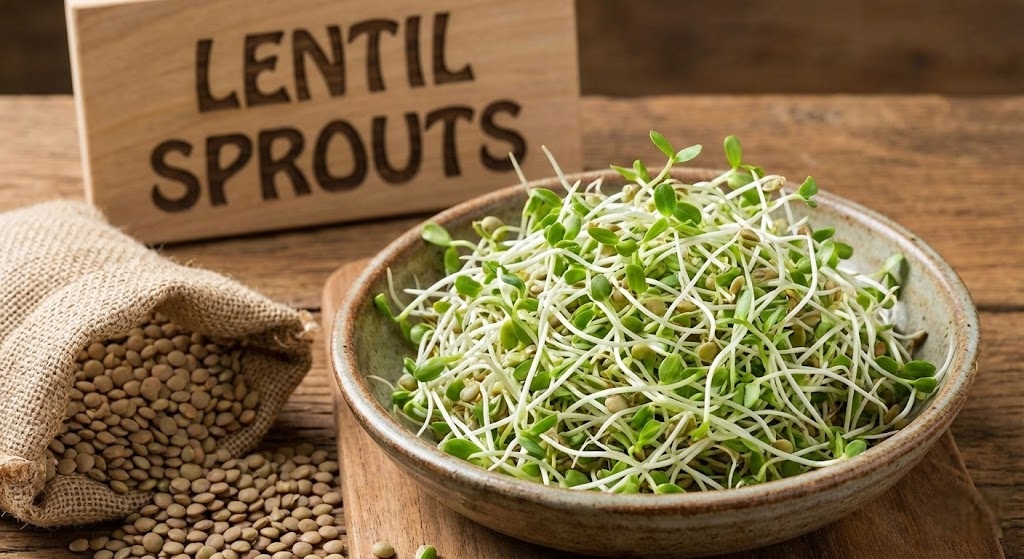
Lentil sprouts are seedlings formed by germinating whole lentil seeds under moist, well-ventilated conditions. Lentils are a type of legume, and the sprouting process not only gives them a crisp, tender texture but also significantly alters their nutritional profile and bioavailability. Compared to mature dried lentils, lentil sprouts are easier to digest and suitable for quickly adding to various dishes. Common lentil varieties suitable for sprouting include:
- Green lentils
- Black lentils
- Du Puy lentils
Note: Split, peeled, or red lentils are generally not recommended for sprouting as they often germinate poorly and have an inferior texture.
Verified Nutrition Facts
The table below uses the USDA FoodData Central entry Lentils, sprouted, raw (FDC 168427). Every value is per 100 g so it matches the site comparison tool. “≈” marks a reference estimate used only when the USDA record does not report that field.
| Nutrient | Per 100 g |
|---|---|
| Calories | 106 kcal |
| Protein | 8.96 g |
| Fiber | ≈ 3.2 g |
| Vitamin C | 16.5 mg |
| Folate | 100 µg |
| Iron | 3.21 mg |
| Calcium | 25 mg |
| Potassium | 322 mg |
Per-100 g figures are a comparison standard, not a suggested serving. Natural variation can occur by cultivar and growing conditions.
🍃 3. Bioactive Compounds & Functional Nutrition
The sprouting process triggers chemical changes within lentils, reducing anti-nutrients (like phytic acid) and increasing the absorption rate of minerals such as iron and zinc, while making protein structures more digestible. Furthermore, lentil sprouts contain:
- Various antioxidants (phenolic compounds)
- B vitamins (e.g., Folate)
- Multiple minerals (Potassium, Magnesium, Iron)
These active components may benefit overall health, but most functional conclusions are based on basic nutrition research and limited intervention studies; more large-scale experiments are still needed for support.
❤️ 4. Potential Health Benefits
The following is a summary based on existing nutritional science and small-scale studies and does not constitute medical advice.
4.1 Provides High-Quality Plant Protein
Lentil sprouts contain 8.96 g of protein per 100 g, making them a good source of plant-based protein suitable for vegetarians and health-conscious individuals.
4.2 Supports Digestion & Gut Health
The selected USDA record does not report fiber for raw lentil sprouts, so this guide does not assign a fiber amount or make a high-fiber claim.
4.3 Antioxidant & Cardiovascular Benefits
Sprouting increases antioxidants, potentially helping to lower LDL ("bad" cholesterol) and raise HDL ("good" cholesterol), which may benefit heart health. Some small randomized studies suggest daily intake of lentil sprouts can improve blood lipid profiles.
4.4 Blood Sugar Management Potential
Some research indicates lentil sprouts may help improve blood sugar control, but such conclusions are preliminary and require higher-quality human trials for support.
⚠️ 5. Consumption Risks & Safety Precautions
5.1 Microbial Contamination Risk
Like all sprouts, the sprouting environment for lentil sprouts (warm and humid) is an ideal breeding ground for bacteria such as Salmonella and E. coli, which can cause foodborne illness.
5.2 High-Risk Groups Should Avoid Raw Consumption
Pregnant individuals, young children, the elderly, and immunocompromised individuals are advised to avoid raw sprouts or choose to consume them only after thorough heating to reduce infection risk.
5.3 Safe Handling Recommendations
- Thoroughly wash sprouts
- Store refrigerated
- Cook (steam, stir-fry, blanch) to enhance safety
- Avoid overcrowded storage to prevent microbial growth
🏡 6. Complete Home Sprouting Process (How-To)
Lentil sprouts are one of the easiest sprouts to make at home, requiring short time and simple steps.
Materials Needed
- Food-grade lentils (unroasted, unprocessed)
- Clean water
- Sprouting container (sprouting tray or glass jar with breathable lid)
Steps
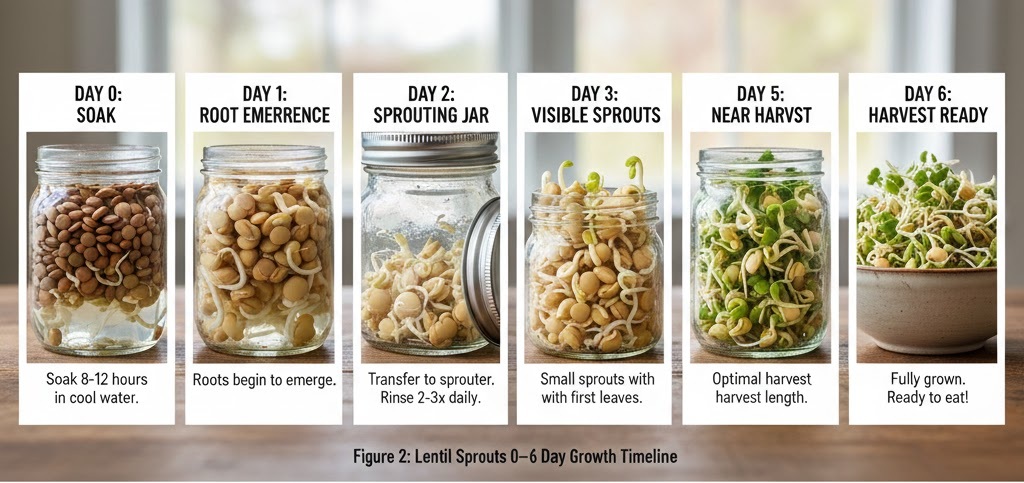
- Soak: Place lentils in clean water for 8–12 hours.
- Drain: Discard the soaking water.
- Transfer to Sprouting Container: Place drained lentils in a container with drainage holes or a breathable lid.
- Rinse & Drain: Rinse with clean water and drain completely 2–3 times daily.
- Harvest: Typically ready in 3–6 days when sprouts are 1–2 cm long.
Chart Description (Figure 2)
Lentil Sprouts 0–6 Day Growth Timeline:A horizontal timeline showing the typical appearance of lentil sprouts from Day 0 (soaking) to Day 6 (harvest).
🍽️ 7. How to Eat Lentil Sprouts
Lentil sprouts can be used in various dishes:
- As a topping for salads or wraps
- In soups or stir-fries
- Mixed into rice or stews
- Made into refreshing appetizers
The decision to eat them raw or cooked should be based on individual health and food safety considerations.
Nutrition Comparison With Other Sprouts
These rows use the same raw sprouted-food records and 100 g basis as our Sprout Nutrition Comparison Tool.
| Raw sprout (100 g) | Calories | Protein (g) | Fiber (g) | Vitamin C (mg) | Folate (µg) |
|---|---|---|---|---|---|
| Lentil Sprouts | 106 | 8.96 | ≈ 3.2 | 16.5 | 100 |
| Mung Bean Sprouts | 30 | 3.04 | 1.8 | 13.2 | 61 |
| Soybean Sprouts | 122 | 13.09 | 1.1 | 15.3 | 172 |
| Alfalfa Sprouts | 23 | 3.99 | 1.9 | 8.2 | 36 |
| Radish Sprouts | 43 | 3.81 | ≈ 2.3 | 28.9 | 95 |
| Pea Sprouts | 124 | 8.8 | ≈ 3 | 10.4 | 144 |
| Sprouted Wheat | 198 | 7.49 | 1.1 | 2.6 | 38 |
❓ 9. Frequently Asked Questions (FAQ)
Q1: Can I eat lentil sprouts every day?
A: For most people, moderate daily consumption is safe, but attention should be paid to washing and food safety.
Q2: Can children eat lentil sprouts?
A: It's recommended that children avoid raw sprouts; cooking them can reduce the risk.
Q3: What's the difference between lentil sprouts, lentil flour, and cooked lentils?
A: Lentil sprouts are germinated seedlings with a different nutritional structure and digestibility compared to cooked dried lentils; each has its own uses.
Q4: How long is the optimal sprouting time?
A: Typically 3–6 days is best, when the sprout length is about 1–2 cm, for optimal nutrient absorption.
📚 10.References & Data Sources
🔹 Nutrition & General Information
Healthline – Bean Sprouts Nutrition, Benefits and Risks
https://www.healthline.com/nutrition/bean-sprouts-nutrition
Healthline – Raw Sprouts: Benefits and Potential Dangers
https://www.healthline.com/nutrition/raw-sprouts
🔹 Lentils & Sprouting-Specific Sources
Harvard T.H. Chan – The Nutrition Source: Lentils & Sprouted Lentils
https://nutritionsource.hsph.harvard.edu/food-features/lentils/
Harvard T.H. Chan – Sprouted Lentils Overview
https://nutritionsource.hsph.harvard.edu/sprouted-lentils/
🔹 Food Safety & Public Health Guidance
WebMD – Are Sprouts Good for You? Benefits and Risks
https://www.webmd.com/diet/sprouts-good-for-you
FDA – Sprouts: What You Should Know
https://www.fda.gov/food/buy-store-serve-safe-food/sprouts-what-you-should-know
CDC – Food Safety and Raw Sprouts
https://www.cdc.gov/foodsafety/communication/sprouts.html
🔹 Scientific & Agricultural References
ScienceDirect – Effects of Germination on Nutritional Properties of Legumes
https://www.sciencedirect.com/topics/agricultural-and-biological-sciences/legume-sprouting
FAO – Pulses and Human Nutrition (Lentils & Sprouts)
https://www.fao.org/pulses-2016/news/news-detail/en/c/429320/
Comparison Tool Data Snapshot
This table is generated from the same data module as the Sprout Nutrition Comparison Tool, so this guide and the interactive comparison stay synchronized. Values are per 100 g fresh weight. “≈” means a species- and stage-matched reference estimate, not a direct measurement of every crop.
| Growth stage | Calories (kcal) | Protein (g) | Fiber (g) | Vitamin C (mg) | Folate (µg) | Iron (mg) | Calcium (mg) | Potassium (mg) |
|---|---|---|---|---|---|---|---|---|
| Whole Sprout | 106 kcal | 8.96 g | ≈ 3.2 g | 16.5 mg | 100 µg | 3.21 mg | 25 mg | 322 mg |
| Microgreen / Shoot | ≈ 49 kcal | ≈ 5.6 g | ≈ 3.8 g | ≈ 28 mg | ≈ 150 µg | ≈ 2.2 mg | ≈ 70 mg | ≈ 350 mg |