
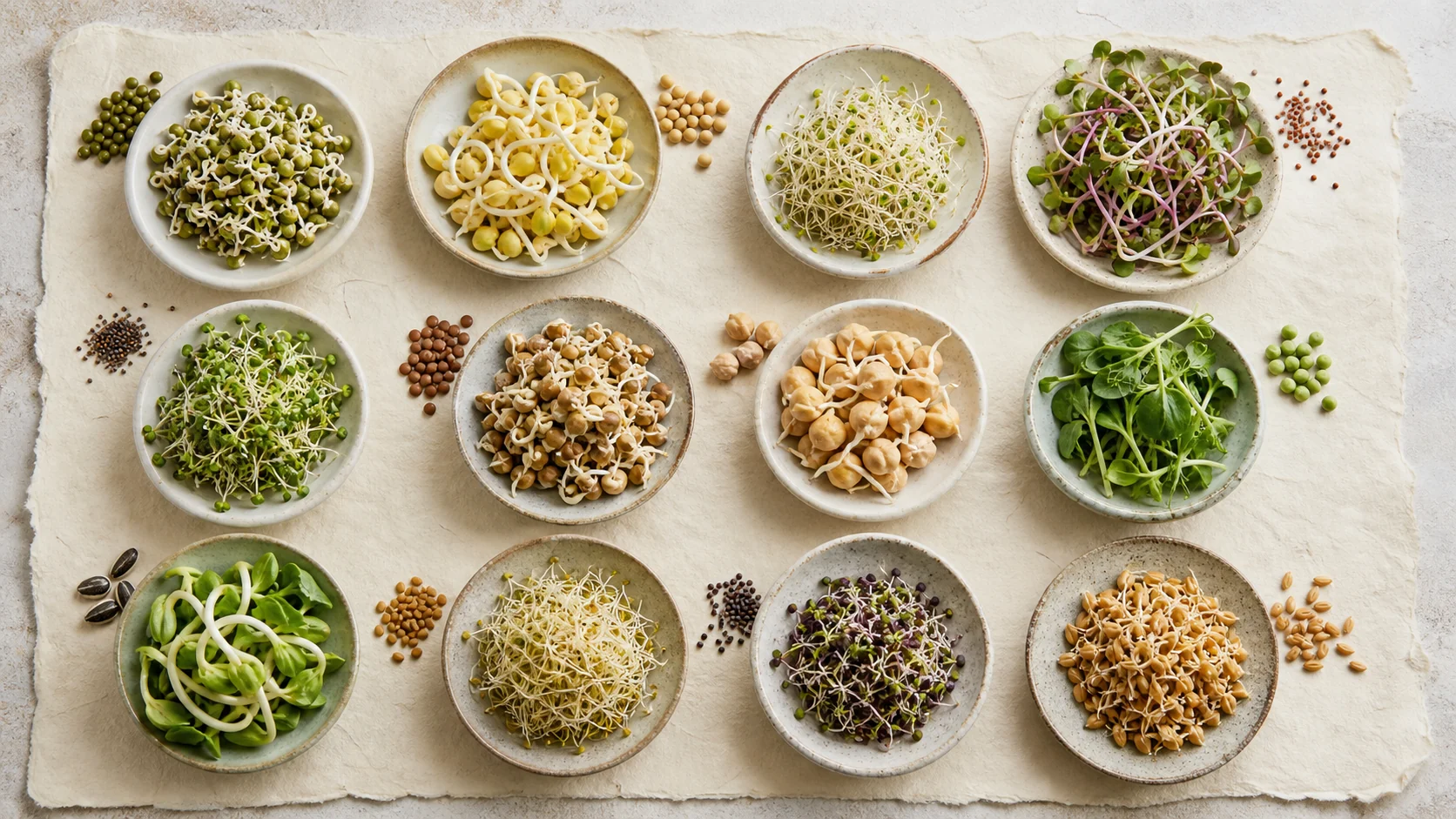
There are many types of sprouts, but they do not all play the same role in a meal. Mung bean and soybean sprouts are thick and suited to cooking. Alfalfa and clover are fine and mild. Radish, mustard, arugula and cress bring peppery heat. Lentil, chickpea and pea sprouts are more substantial, while sunflower and sprouted grains sit closer to shoots or germinated seeds than to the familiar deli sprout.
This field guide compares 20 edible sprout varieties by the differences a shopper or cook can actually use: flavor, texture, common preparation and whether a directly comparable USDA raw-sprout record exists. It does not force every variety into a fake “healthiest sprout” ranking.
Food-safety answer first: Any raw or undercooked sprout can carry harmful germs. The CDC identifies cooked sprouts—heated until steaming hot—as the safer choice. Adults 65 or older, children under 5, pregnant people and people with weakened immune systems should avoid raw or undercooked sprouts.
20 Types of Sprouts at a Glance
The field-guide key
Three working families, not one ranking
Bean & legume
Crunchy, substantial, usually best cooked
Leafy & brassica
Fine stems, from mild to sharply peppery
Seed & grain
Nutty, bitter or malty; harvest stage matters
Name → flavor → use
The 20-variety pocket guide
A practical identity card, not a repeated nutrition claim.
Comparable records only
Two charts, seven exact USDA entries
Varieties without an equivalent raw-sprout record are left out instead of being filled with estimates or mature-vegetable data.
USDA raw records · per 100 g
Protein
USDA raw records · per 100 g
Vitamin C
Per 100 g is a laboratory comparison basis, not a suggested serving. Natural foods vary by cultivar, moisture, growing time and storage.
From dry seed to open cotyledons
Press play for a five-second illustrated motion loop. It is a visual guide to the sequence—not real-time growth footage.
The stage at harvest changes texture, flavor and whether the product is better described as a sprout, shoot or microgreen.
What Counts as a Sprout?
A sprout is the early growth of a germinated seed. It is normally harvested while the seed, root and emerging shoot are still eaten together. That makes sprouts different from microgreens, which are allowed to develop leaves and are usually cut above a growing medium.
The boundary is not always tidy in everyday language. Pea and sunflower products sold as “sprouts” are often tray-grown shoots. Wheat may be eaten as a short germinated grain or grown longer as wheatgrass. The useful question is therefore not only which seed?, but also at what stage was it harvested, and is the seed/root still attached? For a stage-by-stage comparison, read our sprouts vs. microgreens guide.
Bean and Legume Sprouts: Crunch, Body and Cooking
This group retains a noticeable piece of the original bean or pulse. The result is more body, a firmer bite and, for several varieties, substantially more protein per 100 grams than delicate leafy sprouts. These are the sprouts most likely to feel like an ingredient rather than a garnish.
Mung Bean and Soybean Sprouts
Mung bean sprouts have pale, juicy stems, small yellow-green heads and a clean crunch. They tolerate quick heat well, which is why they appear in stir-fries, noodle soups and fresh rolls. Soybean sprouts have larger yellow heads, a more pronounced bean flavor and a denser texture. They are especially suited to blanching, soup and seasoned side dishes.
“Bean sprouts” on a package or menu does not identify one universal food. In many markets it means mung bean sprouts; in Korean cooking it often means soybean sprouts. Their USDA nutrient profiles are also very different, so one should not be used as a nutrition substitute for the other.
Lentil, Chickpea, Pea and Adzuki Sprouts
Lentil sprouts stay earthy and pleasantly firm, fitting warm salads, soups and grain bowls. Chickpea sprouts are dense and nutty; cooking gives them a more familiar chickpea texture and is the safer preparation. Pea sprouts range from short germinated peas to longer green shoots, so the label and harvest stage matter. Adzuki bean sprouts are less common, mildly nutty and best treated as a pulse to be cooked rather than as a delicate raw topping.
Leafy and Brassica Sprouts: Mild to Peppery
These small-seeded sprouts form fine stems and tiny cotyledons. Their flavor range is much wider than their similar appearance suggests.
Alfalfa and Clover: The Mild Pair
Alfalfa sprouts are soft, feathery and mild enough for sandwiches and wraps. Clover sprouts look similar and taste slightly greener. Neither should be treated as a major protein source in a normal handful, and neither is made safe simply by looking fresh. Their delicate structure is a culinary feature, not a safety signal.
Broccoli, Radish, Mustard and Red Cabbage
Broccoli sprouts have a mustard-like bite and are usually chosen for their glucosinolate and sulforaphane context rather than basic calories or protein. Radish sprouts are brighter and more peppery, making a small amount noticeable in tacos, sandwiches and savory bowls. Mustard sprouts can be sharper still. Red cabbage sprouts add a purple-green color accent with a gentler brassica flavor.
Kale, Arugula and Cress
Kale sprouts are mild for a brassica and work where broccoli sprouts would taste too assertive. Arugula sprouts have a savory pepperiness familiar from mature arugula leaves. Cress sprouts are brisk and sharp, traditionally paired with eggs, sandwiches and creamy foods that soften their bite. These three are useful flavor tools; their names are not evidence that their nutrient values match the mature vegetables.
Seed and Grain Sprouts: Nutty, Bitter or Malty
Sunflower sprouts are thick, juicy and nutty, often grown in trays until they resemble young shoots. Fenugreek sprouts have a distinctive bitter, curry-like character that works better with assertive dressings or cooked pulse dishes than in a neutral sandwich.
Sprouted wheat is a germinated grain with a sweet, nutty flavor; it is different from long-grown wheatgrass. Sprouted barley is similarly associated with malty flavors and is more often cooked or processed than used as a fresh garnish. Quinoa sprouts remain small and earthy. Quinoa should be rinsed thoroughly, and sprouting does not remove the general microbial risk that applies to all sprouts.
How to Choose a Sprout for the Meal You Are Making
| If you want… | Start with… | Why |
|---|---|---|
| A mild sandwich layer | Alfalfa or clover | Fine texture and restrained flavor |
| Crunch that survives quick cooking | Mung bean | Juicy stems stay crisp in stir-fries and soups |
| A substantial cooked sprout | Soybean, lentil or chickpea | Larger seed portion and firmer bite |
| A peppery garnish | Radish, mustard, arugula or cress | A small amount adds noticeable heat |
| A sulforaphane-focused option | Broccoli | Chosen for glucoraphanin/sulforaphane research, not because it wins every nutrient |
| A nutty green for a bowl | Sunflower | Thicker, juicier and more filling than fine sprouts |
| A bitter, aromatic accent | Fenugreek | Distinctive flavor stands up to pulses and strong dressings |
What the Nutrition Chart Can—and Cannot—Tell You
The visual chart on this page uses seven USDA FoodData Central SR Legacy records: mung bean, soybean, alfalfa, lentil, radish, pea and wheat, all listed as raw sprouts or sprouted grain and compared per 100 grams. That shared basis makes the bars comparable.
It does not mean 100 grams is a recommended serving, and it does not mean an uncharted sprout contains zero of a nutrient. Broccoli, chickpea, sunflower, fenugreek and the other varieties were deliberately left out of the numeric chart when we did not have an equivalent USDA record in the same dataset and food state. Filling those gaps with mature-vegetable data or unrelated laboratory samples would create precision without comparability.
Natural foods also vary by cultivar, growing time, moisture and storage. Use the chart to understand large differences—such as soybean sprouts being much denser in protein than mung bean sprouts—not to calculate a clinical dose. For more nutrients and transparent source notes, open the Sprout Nutrition Comparison Tool.
Food Safety Applies to Every Type of Sprout
Sprouts need warmth, moisture and nutrients to germinate. The FDA explains that those same conditions are favorable for pathogen growth if contamination is present. Seeds have repeatedly been identified as a likely source in sprout-associated outbreaks, which is why a clean kitchen and regular rinsing reduce mess but cannot guarantee pathogen-free raw sprouts.
- Choose cooking when possible. The CDC lists sprouts cooked until steaming hot as the safer choice.
- High-risk groups should avoid raw or undercooked sprouts. This includes pregnant people, children under 5, adults 65 or older and people with weakened immune systems.
- Rinsing is not sterilization. Wash produce and prevent cross-contamination, but do not describe rinsing as a kill step.
- Check current recalls. A product can look and smell normal and still be implicated in an outbreak.
- Discard spoiled sprouts. Slime, mold, darkening or a sour/off odor are reasons to throw the batch away, not to taste-test it.
See the CDC’s safer food choices and the FDA’s sprout safety guidance for the underlying public-health recommendations.
Frequently Asked Questions
How many types of edible sprouts are there?
There is no single official count. Many edible grains, legumes and vegetable seeds can be germinated, and the result may be sold as a sprout, shoot or microgreen depending on how long it grows and how it is harvested. This guide uses 20 recognizable kitchen varieties rather than claiming a complete botanical inventory.
What is the healthiest type of sprout?
No evidence-based answer ranks one sprout as healthiest for everyone. Soybean and lentil sprouts contribute more protein per 100 grams than delicate leafy sprouts. Radish leads the seven USDA entries on this page for vitamin C. Broccoli sprouts are selected for a different reason: their glucosinolate and sulforaphane context. Safety, serving size and the rest of the meal matter as much as a single nutrient.
Are all bean sprouts mung bean sprouts?
No. Mung bean and soybean sprouts are the two common meanings of “bean sprouts,” and they differ in appearance, flavor, cooking behavior and nutrient composition. Lentil, chickpea, pea and adzuki can also be sprouted, but they are usually named explicitly.
Which sprouts can be eaten raw?
Many varieties are commonly served raw, but “commonly served” does not mean risk-free. CDC guidance treats any raw or undercooked sprout as the riskier choice and cooked sprouts as the safer choice. People in higher-risk groups should avoid raw or undercooked sprouts of every variety.
Are sunflower and pea sprouts really microgreens?
Sometimes. A short germinated seed eaten with its root is a sprout. A longer tray-grown plant cut above the medium is a shoot or microgreen. Retail names are inconsistent, so check the harvest stage rather than relying only on the label.
Sources and Methodology
- USDA FoodData Central data-type documentation
- USDA FoodData Central: mung beans, mature seeds, sprouted, raw
- USDA FoodData Central: soybeans, mature seeds, sprouted, raw
- USDA FoodData Central: alfalfa seeds, sprouted, raw
- USDA FoodData Central: lentils, sprouted, raw
- USDA FoodData Central: radish seeds, sprouted, raw
- USDA FoodData Central: peas, mature seeds, sprouted, raw
- USDA FoodData Central: wheat, sprouted
- CDC: Safer Food Choices
- FDA: Standards for sprouts for human consumption
How this guide was made: SproutsDaily editors grouped varieties by their real role in a meal instead of repeating one template 20 times. Numeric charts use only directly comparable USDA raw-sprout or sprouted-grain records; varieties without an equivalent record were intentionally left unscored. Food-safety language was checked against CDC and FDA pages on August 30, 2026. The hero, germination illustration and lightweight motion study were created specifically for this page. This article is educational and does not replace individualized medical advice.